Death, Bitcoin and Taxes: Three Certainties in Life

This is a follow up to my thoughtpiece on Bitcoin utility: Beyond the HODL: Unlocking Bitcoin’s Utility

The title may be clickbait – tax isn’t a sexy topic – but nearly every BitcoinFi company building for institutions that I have spoken to sees it as a major barrier to entry. Tax obligations for Bitcoin and cryptoassets (since they are treated as property rather than currency in most jurisdictions) touch everything from payments to staking and lending. The elephant in the room is tax, and it remains a stubborn barrier to widespread adoption.

For individuals, it’s confusing and annoying. For institutions, the time dedication and compliance risks are several magnitudes higher. Internal tax teams worry about derivatives accounting, GAAP vs. IFRS treatment and quarterly mark-to-market requirements. I nearly had a major partnership deal unwind for exactly this reason! If the tax burden is not minimized, a tentative “Yes” can quickly become a hard “No” to the adoption of Bitcoin-led products.

The issue boils down to this: every movement of Bitcoin is a taxable event. While some countries have carved out narrow exemptions, the US and most OECD members have not. For BitcoinFi builders the table stakes are not just transparency (after all, this is an easy win for blockchain tech!), but robust infrastructure. This means reliable transaction data, technical attestations, audit rails and cost basis reconciliation, as well as API-led reporting that institutions can mold into their own views. These systems need to run 24/7/365 and feature excellent SDKs and templates with integrations directly into enterprise backbones like SAP and Oracle.

The crypto tax software market, worth $4.2B in 2024 and projected to exceed $10B by 2029, with a CAGR of 20%1, is mostly retail-driven today. Institutional needs are far greater, and the compliance burden in both time and money is likely to be 5-10X greater.

While it’s tempting to think stablecoins (fiat-denominated cryptocurrencies that effectively skip the tax issue because they are fiat pegged) are the solution2, I would argue these are inferior solutions that simply paper over the inconvenient tax treatment that Bitcoin suffers today.

Stablecoins appear to solve this by sidestepping capital gains calculations – and current adoption reflects that. Visa Onchain Analytics reported $8.5T in stablecoin transaction volume over the past 12 months3, compared with Bitcoin payments via Lightning which remain a tiny fraction of global settlement flows (optimistically estimated at 5%). But this is only a workaround. Stablecoins are inferior long-term and true adoption of Bitcoin is worth fighting for. The holy grail for BitcoinFi companies is simple: Bitcoin transactions should be recognized as currency movements, not taxable events.

Until then, progress will occur incrementally. A de minimis exemption for small payments (in current US proposals, under $2004) would remove friction for small day-to-day transactions. Global coordination of regulatory and legal requirements is also advancing, with the OECD’s Crypto-Asset Reporting Framework (CARF) set to standardize disclosure requirements across borders.

Meanwhile, staking (and/or wrapping) and lending of Bitcoin is more complicated. If a holder maintains custody of their Bitcoin it is generally not considered a taxable event, but wrapping it into another token often is (at least under US rules). Non-custodial staking is unlikely to be appealing to yield providers and lenders. Here lies a genuine design challenge for BitcoinFi companies.

The way forward is clear. Let’s be proactive while embracing the tax reality we currently have, build products that make compliance seamless, and keep lobbying for policy change. Best-in-class solutions will mean real-time cost basis reporting, the ability to export directly into tax forms, architecture that is ISO27001 and SOC2 compliant, and above all, integrations that make tax issues invisible to partners and auditors alike.

If Bitcoin is to power global settlement, we don’t just need 24/7 and cheaper rails. We need clarity and compliance – and the companies that deliver both will be the ones that succeed.

  1. https://www.thebusinessresearchcompany.com/market-insights/crypto-tax-software-market-insights-2025 ↩︎
  2. Though the IRS has said stablecoins are also property, meaning USDC > USDT swaps (for example) could technically be taxable, even if de minimis. ↩︎
  3. https://visaonchainanalytics.com/ ↩︎
  4. Per current de minimis tax exemption proposals in U.S. Congress (the “Virtual Currency Tax Fairness Act”). ↩︎

Beyond the HODL: Unlocking Bitcoin’s Utility

I want to talk about something potentially controversial – but timely – after spending a few days immersed in conversations at Bitcoin 2025 in Las Vegas.

We’re all Bitcoiners. I don’t need to convince you of bitcoin’s soundness or the uniqueness of the Bitcoin network. But I do want to explore how we can do more with our BTC. How to extract more utility from bitcoin beyond simply HODLing it as a store of value.

Many of us feel we’ve escaped fiat decay and taken control of our financial destiny. But in practice, we’re often left cash flow neutral (or worse) with assets we don’t want to sell, and limited ways to tap into their value.

So let’s talk about four approaches to increasing bitcoin’s utility:

  • Spending it
  • Buying bitcoin-adjacent instruments
  • Staking it to earn yield
  • Borrowing against it

The case for spending

Bitcoin’s store-of-value status is well earned, but its original purpose was as money. It says so in the very title of Satoshi’s infamous white paper: “A Peer-to-Peer Electronic Cash System.” Ignoring Bitcoin’s payment function risks weakening its potential as the future financial system.

The Lightning Network is the best (current) way to bring bitcoin’s payments vision to life. It enables instant, low-cost global transactions and is growing more robust by the day. I’ve been running a Lightning node for a while now, and while it’s taught me a ton, you don’t need to be a technical wizard to participate.

Even without running a node, you can use Lightning to send and receive bitcoin instantly, with better UX than many banking apps. (And, if you do venture into running your own Lightning node – and I highly recommend it – you can earn modest but real yield through routing fees if you manage channels efficiently.)

Look out for:

  • Cash App https://cash.app/ | Possibly the slickest UX and on/off ramp for making payments with bitcoin.
  • Lightning Labs https://lightning.engineering/ | Early mover offering a Layer 2 protocol for building Lightning-powered applications.
  • Lightspark https://www.lightspark.com/ | Brainpower from the team behind Libra now focused on enabling institutions to scale Lightning payments. 
  • Umbrel https://umbrel.com/ | An approachable way to run a Bitcoin+Lightning node with an active and helpful community.

The case for investing

If you’re bullish on BTC’s long-term trajectory, you can express that view through exposure to bitcoin treasury companies or structured funds that track bitcoin performance – often with easier access and tax benefits if you invest in a pension or other efficient wrapper (DYOR, not financial advice).

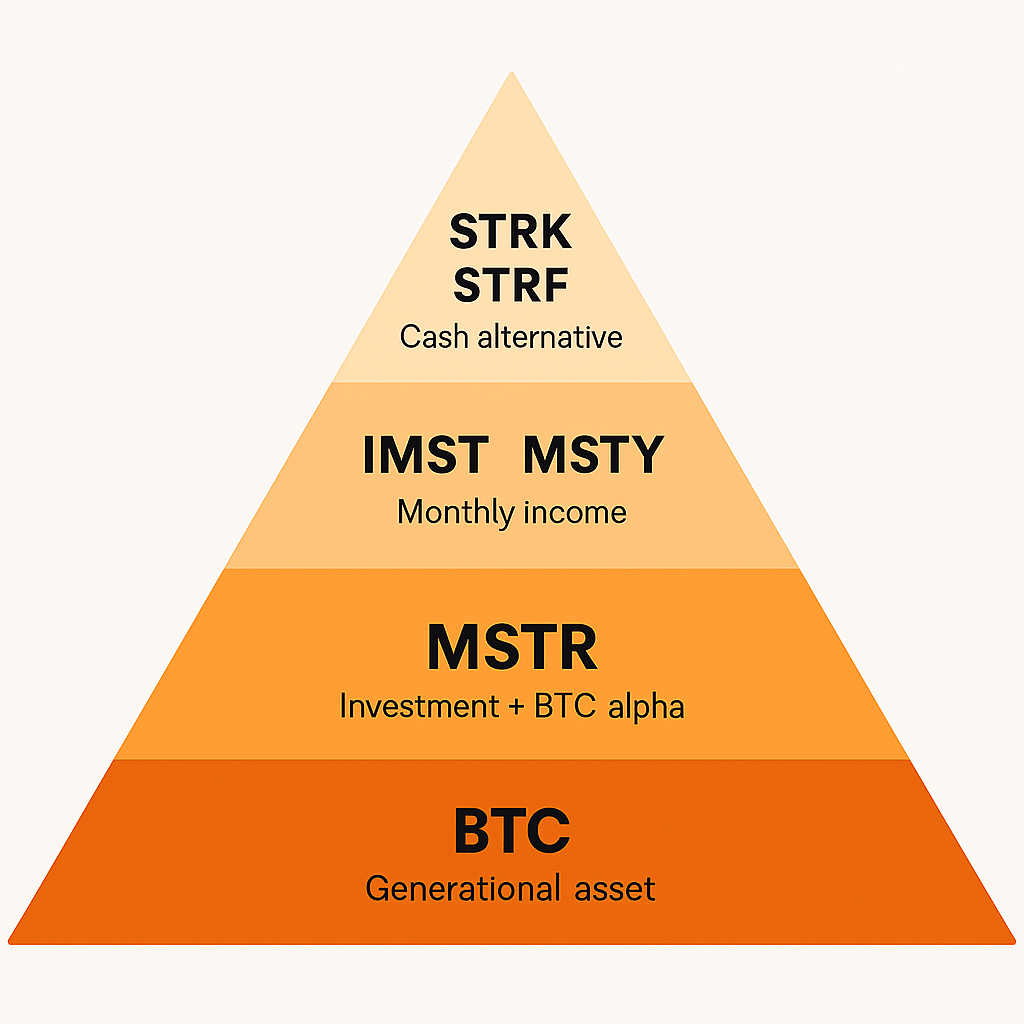
Michael Saylor’s MicroStrategy ($MSTR) is the original Bitcoin proxy. But new contenders are now vying for the crown of the purest and most transparent bitcoin treasury company. Furthermore, products like $MSTY and $IMST have emerged to offer leveraged or derivative exposure, and $STRK or $STRF are pushing the idea of stable, income-oriented bitcoin-backed instruments even further.

I’m personally using MSTR options to speculate with limited capital at risk, but structured funds might be appealing for those seeking passive exposure or looking to diversify their existing portfolio.

Look out for:

  • Bitwise https://bitwiseinvestments.com/ | Leading crypto asset manager with thoughtfully designed products, bleeding-edge quants and a commitment to funding open-source development.
  • Strategy https://www.strategy.com/ | The OG Bitcoin treasury company. “There is no second best” – Michael Saylor.
  • Twenty One https://xxi.money/ | Backed by Cantor Fitzgerald and Softbank, aiming to build the most transparent bitcoin fund yet.

The case for staking

This was the hot (over-hyped?) topic at Bitcoin 2025 – and also the most misunderstood.

Let’s be clear: staking bitcoin is not the same as staking in proof-of-stake systems like Ethereum. Bitcoin doesn’t have a native staking mechanism. So when a provider offers “bitcoin staking” what they really mean is: your bitcoin is being deployed in a strategy that generates yield, and they’ll share a portion with you.

This raises critical questions:

  • What is my BTC being used for?
  • Is it being lent out, wrapped, or used as collateral?
  • Who controls custody?
  • Is the yield sustainable – or subsidized?

One standout company building in this space is Acre. You deposit BTC and earn BTC, without needing to convert it into tokens or move off-platform. Behind the scenes, Acre uses secure and decentralized infrastructure to put your BTC to work, with yield coming from demand to rent liquidity for leverage – akin to an on-chain money market. It’s early days, but the design aligns incentives well and emphasizes transparency and user control.

TL;DR If you’re going to stake your BTC, make sure you understand the mechanics and the risks.

Look out for:

  • Acre https://acre.fi/ | Backed by Thesis. An on-Bitcoin yield protocol offering native BTC compounding to consumers and institutions.

The case for borrowing

This one almost needs no introduction. If you need cash but don’t want to sell your BTC, borrow against it. The idea is as old as finance itself – securing a loan with collateral – but Bitcoin makes it programmable.

The big concern here is rehypothecation: are your coins actually held 1:1, or are they being reused behind the scenes? Trust and transparency are key. There’s also market risk: you’re using leverage (true, even if it doesn’t feel like it!). If BTC drops, your loan may be liquidated unless you top up your collateral.

Ask yourself:

  • Can I support interest payments if my income drops?
  • What are the margin requirements and what happens if bitcoin’s value declines?
  • Who are the underlying capital providers, and in what circumstances can they exercise rights to my bitcoin?

Still, when done responsibly, this can be a tax-efficient way to fund fiat expenses – or buy more bitcoin – without selling your stack.

Look out for:

  • Mezo https://mezo.org/ | Built by Thesis. Bitcoin-backed lending with a promised competitive borrowing rate. Mainnet was launched during Bitcoin 2025.
  • Strike https://strike.me/ | The Bitcoin financial products company that never fails to amaze with its ability to ship fast and delight users.

From HODL to Action

Bitcoin is pristine collateral. It’s hard money. It’s digital gold. But for Bitcoin to become the backbone of a new financial system, we need to use it, not just stack it.

Consider how spending, staking and borrowing and experimenting with bitcoin-adjacent products fit within your risk appetite. And let’s help the buidlers out there create a world where Bitcoin powers real economic activity – without compromising what makes it special.

Should Bitwise launch a managed NFT fund?

A thought piece reflecting on a side degen project I ran in 2023 and a potential opportunity for a leading crypto fund manager. Just for fun. All thoughts and opinions expressed are my own.

NFTs [Non-Fungible Tokens] have served as a gateway into crypto for millions. Unlike many digital assets, NFTs don’t require deep technical knowledge to spark curiosity. The appeal of a Pudgy Penguin or an XCOPY 1:1 speaks for itself. Communities have formed around top collections, often delivering outsized returns to those fortunate enough to mint a genesis NFT.

Yet institutional-grade access remains limited. Bitwise was an early mover, launching its Blue-Chip NFT Index Fund in 2021, but there’s still no pathway for deeper, more dynamic exposure aligned with the true nature of this market.

A Strategic Fit for Bitwise

Bitwise was founded to provide clean, compliant and understandable access to digital assets. Applying a fund manager’s mindset to a tech-native domain, they’ve simplified access, reduced friction and built investor trust.

A managed NFT fund would be a natural extension of this approach. NFTs remain daunting even for established crypto investors, facing barriers around custody, pricing and trust. Bitwise has the brand, infrastructure and qualified distribution network to overcome these challenges once again – this time in the rapidly evolving world of Web3 culture and digital collectibles.

Such a fund would differentiate Bitwise strategically. Most institutional managers remain on the sidelines of NFTs, constrained by traditional valuation frameworks and benchmarking fears. Bitwise could step boldly into this space, reinforcing its innovative edge and potentially delivering outsized returns.

The Opportunity: Big, Underserved and Ripe for Structure

At its peak in 2022, NFT sales volume reached $23.7B (Cointelegraph). Although the market cooled in 2023-24, recovery is well underway. Projections estimate the NFT market will reach $35.7B in 2025 and expand to $211.7B by 2030 (Grand View Research), representing a CAGR of over 41%.

Recent high-profile sales illustrate renewed interest: CryptoPunk #3100 sold for $16M (4,500 ETH) and “Fidenza #313” by Tyler Hobbs went for over $3.3M. While these could be considered exceptional, these sales highlight the broader appeal and potential of digital collectibles.

Yet there’s no agreed definition of a “blue-chip” NFT. Even among crypto veterans, passionate disagreements persist. Factors like emotional resonance, historical significance and collector sentiment complicate traditional valuation frameworks.

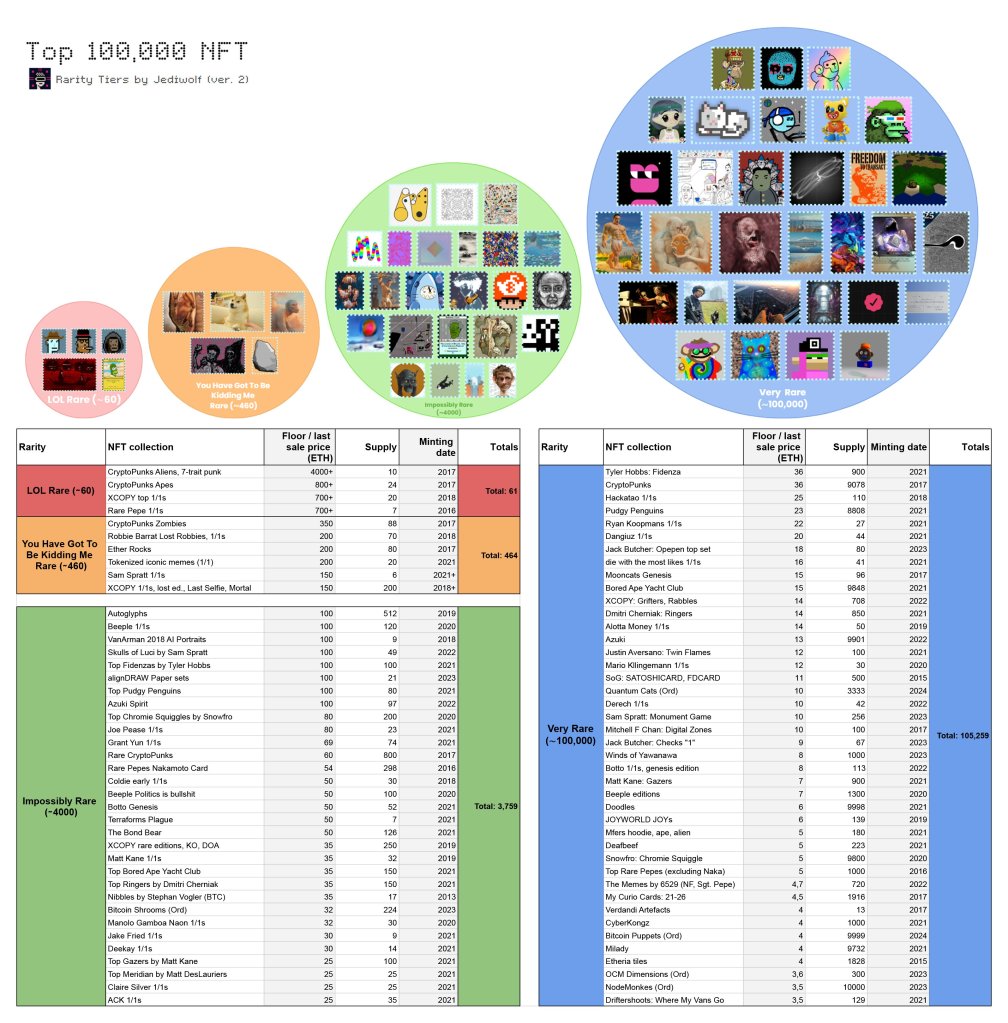
In January 2025, respected NFT researcher/collector ‘Jediwolf’ attempted to rank the top 100,000 NFTs. Initial consensus quickly dissolved into debate, leading Jediwolf to conclude “some people will inevitably be dissatisfied and there’s little that can be done to appease everyone” (tweet). This highlights the complexity and emotional depth of NFT investing – a domain ripe for a structured, data-driven approach.

Bitwise could lead by developing a sophisticated model that blends cultural signals with on-chain data, offering investors diversified, real-time exposure to this opaque asset class.

A Personal Experiment: Building a Model

During summer 2023, I attempted to create such a model-driven fund. Friends frequently asked how to invest in NFTs, and I realized I lacked a definitive answer. I began developing a model focused on investing in top NFT collections and exiting based on multiples or market indicators.

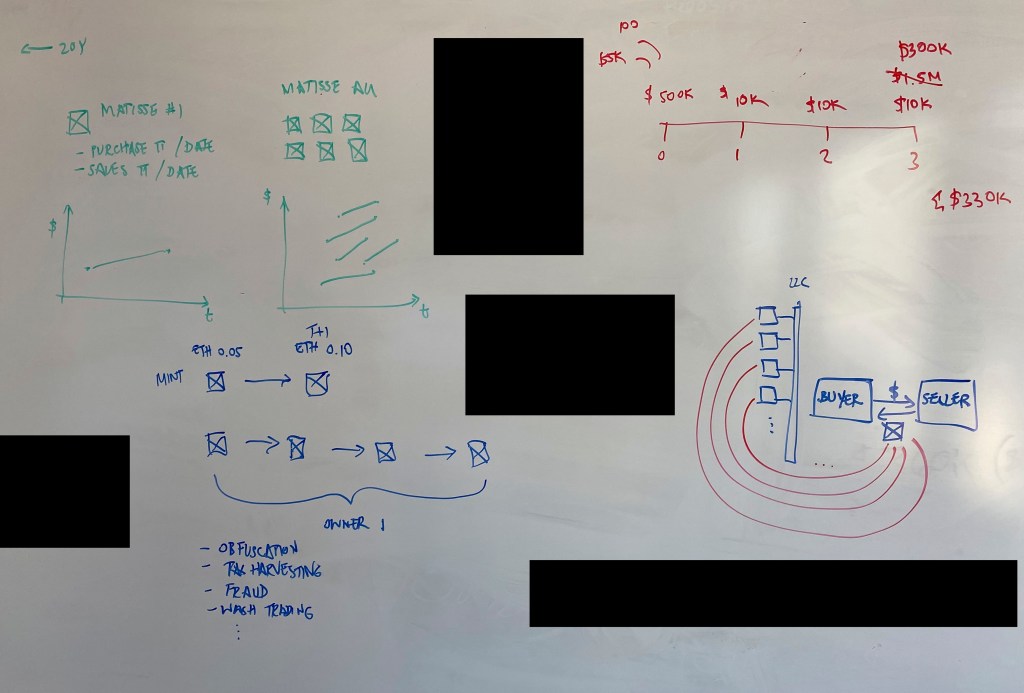
Working with Dune Analytics, I analyzed NFT trading pairs – items with observable buy/sell history – organized by collection, rarity traits and historical performance. However, extensive wash trading and bot activity obscured meaningful data, and the rapid emergence of NFTs on new chains (Bitcoin Ordinals, Solana’s Mad Lads, to name only two) quickly outdated my initial models. Continuous updates were clearly necessary, though the concept itself remained sound.

Beyond investor returns, such analytics could also benefit custodians, insurers, and digital and physical auction houses. These stakeholders could contribute to model insights, offsetting operational costs and amplifying industry interest.

Additionally, NFTs often offer utility such as event access, pre-mints, or airdrops – benefits that fund investors could directly enjoy, providing tangible value beyond price appreciation.

Challenges (and Why Bitwise Is Better Equipped)

Despite initial enthusiasm, my project stalled due to the required upfront capital, regulatory uncertainty and limited short-term returns. Investors showed intrigue, but hesitated without institutional backing. I shelved the idea, until a chance encounter at a recent crypto event brought it back to mind.

Bitwise – unlike individual entrepreneurs – possesses the infrastructure, trust and regulatory expertise needed. Still, risks remain significant. NFTs carry reputational and emotional weight – one controversy can rapidly depress floor prices.

Practical questions also persist: What regulatory jurisdiction will the fund choose, and how will it affect investor eligibility? What rights will investors have over the NFTs? Issues around intellectual property, usage, airdrops, and perks must be addressed transparently.

Liquidity also poses a challenge. Unlike most Bitwise products, NFTs from top collections often lack immediate market liquidity. Clear communication regarding lockups, redemption terms and valuation will be essential, though liquidity should naturally evolve as the market matures.

Time to Go Beyond the Basics

Bitwise’s existing Blue-Chip NFT Index Fund, based on quarterly rebalancing, was appropriate in the market’s early days. Today’s NFT ecosystem demands more sophisticated, data-informed models capable of capturing real-time nuances. Get this right and the potential is enormous!

A Next Frontier

Launching a managed NFT fund aligns perfectly with Bitwise’s mission of democratizing crypto investing. Leveraging its strengths – education, compliance, trust – Bitwise could confidently pioneer this next frontier in digital assets.

So, Hunter – how about it? 🙂

The Future

In earlier posts, I shared my career arc, motivations and the systemic issues plaguing our global financial system.

👋 I quit a cushy ‘TradFi’ career to go back to school and bone up on nascent technologies (big data, ML, AI), aiming to leverage them in a more socially impactful career. That path is still evolving, but I know I thrive in collaborative environments with a growth mindset and a mission to disrupt financial services.

⛓️ The most promising tech I have explored over the last decade is blockchain, specifically the Bitcoin protocol. It is the perfect intersection of math, economics and psychology, to keep me fully engaged.

🧠 For those without the time – or, candidly, the brainpower – to dig into the Bitcoin White Paper, here is a summary of blockchain’s key benefits for reimagining financial services.

Transparency – Bitcoin lets anyone with a basic computer download and verify the entire transaction history since Block 0 (January 3, 2009). Every transaction (or block) is scrutinized and validated by (node or miner) participants, reducing fraud and boosting trust.

Security – Bitcoin’s cryptographic foundation ensures transactions are secure and tamper-resistant, safeguarding against hacking. Once recorded, transactions cannot be altered (immutability), ensuring data integrity.

Inclusion – Blockchain offers decentralized alternatives for unbanked populations, bypassing TradFi’s infrastructure. Bitcoin’s supply is capped at 21M bitcoin with ~93% already mined. Supply is controlled by code, not governments. 1 bitcoin == 1 bitcoin, the most robust unit of currency ever.

Efficiency – Bitcoin is not tied to any nation or profit-driven company. It is fully decentralized, and everyone in the network has a voice. By eliminating intermediaries and automating with code, on-chain transactions are faster and cheaper.

⚡️ There are several top notch applications on the Bitcoin protocol that enable users to transact at lightning speed with close to zero cost – it is literally called “Lightning.” Check out Strike (https://strike.me/), Lightning Labs (https://lightning.engineering/) and Lightspark (https://www.lightspark.com/).

Available – Bitcoin is online 24/7/365. It is virtually impossible to stop or attack the network due to the immense computing power required. China banned Bitcoin mining in 2021 (for the third time!) but new mining capacity seamlessly emerged elsewhere. Even a global superpower cannot disrupt availability.

📈 We are still in the early days of Bitcoin and blockchain tech. It is an uphill battle to educate and convince friends and colleagues, especially with bad actors making it easy to dismiss its potential.

🌐 Yet, I cannot imagine a future where blockchain does not power the digital economy, real world asset tokenization, and digital identity verification. Blockchain is fueling Web3 – a decentralized internet where users control their data, identity and digital assets. There are 400M+ wallets active crypto wallets today. How the UX feels at 1B+ users will be vastly different.

💪 The possibilities are immense and complex. We have never seen such a global technology expand in a completely decentralized way. It is complicated, we will make mistakes, but the upside of a decentralized future is worth fighting for!

🤙 I am excited to keep experimenting and applying my product, business development and growth skills to drive blockchain adoption in financial services, Web3 and beyond. If you are building – or just curious about building – with blockchain technology, reach out!


Sources:

https://go.chainalysis.com/crypto-spring-report.html

What Is Wrong

In my last post, I touched on the inequities I’ve witnessed in life, and I’d like to explore this further and explain why it motivates me.

🌎 Globally, 1.4B people, including 6M Americans, lack access to a bank account. This exclusion means no access to savings, credit, or other financial tools many of us take for granted.

🤡 Even for those with access, many (I’d argue the vast majority) are still getting poorer. At its core, the financial system is a government-controlled game that perpetuates inequality. Banks and financial institutions, heavily influenced by the government, contribute to an economy that is swiftly descending into a “clown-world”.

💸 The US national debt stands at $32.7T, projected to reach $40T by 2030. In 2023, the US paid $659B in interest on this debt, surpassing the budgets of the Departments of Defense, Veterans Affairs, and Education combined. By 2030, interest payments could hit $1.4T. This problem isn’t unique to the US; in fact, many other developed countries are in even worse situations.

📈 The fragility of the system became clear to me after the 2008 global financial crisis (GFC). It was evident that the US, UK and EU governments would not allow a bank failure to crash their economies, leading to skyrocketing asset valuations. The money printers whirred into action, driving inflation and the devaluation of the Dollar, Pound and Euro. People with assets got richer, while those without struggled even more.

🏦 Since 1971, when the US abandoned the Gold standard, our currencies have been fiat-based, meaning their value isn’t backed by physical commodities but by government decree. This shift enabled central banks to inflate the currency at will, with governments ensuring asset prices wouldn’t collapse.

💔 Regulations intended to “protect” consumers often restrict access to wealth-building products, making it hard for average people to build wealth. It’s much easier to make $1M when you already have $1M, but getting there from zero is a lifetime’s challenge. Baby Boomers had the ride of their lives, while Millennials and Gen Z are disillusioned with the whole circus. Our broken financial system has led to a broken society.

👋 As a ‘Xennial,’ I grew up with the capitalist dream and saw the benefits of past government policies. My career began during the dot-com boom as an investment banker. I was fortunate with timing and circumstances, but I left that life behind to be part of the solution.

💡 My vision is to develop products that make financial services easier to access and simpler to understand – leveraging new technologies – so that everyone has the tools to build the life they want using the building blocks of a new global financial system.

💪 Since the GFC, I’ve developed new financing solutions for small and medium-sized ecommerce businesses, including region-specific programs for Amazon and simplifying and expanding a global product at Storfund. There’s still much work to do, and I encourage anyone in or considering the tradfi system to explore alternative options. Now is the time to be bold!

Stay tuned for more on a solution that could rewrite our financial system!


Sources:

Who I Am

👋 Hi! I’ve had the privilege of making many connections, so I figured it was time to “reset” and share a bit about who I am and what I’m up to.

🌏 I began my career during the tail end of the dotcom crash, landing a job as an investment banking analyst. I spent 12 years in the City of London, covering debt and equity markets across Asia, Europe and the US. The last four years of my banking career were spent as a country lead managing a portfolio of maritime companies in Greece.

💵 During that time, I started to think about what I truly wanted to do in life. While I helped clients raise billions of dollars to grow their businesses, I also witnessed the harsh realities faced by many migrants escaping war, political suppression and poverty. It was difficult to reconcile my work lifestyle with the struggles of those who lived in fear and economic hardship.

💻 I’ve always been a curious tech kid. Growing up, I loved dismantling electronics, building simple computers, and running side hustles – so banking soon felt too archaic for me. I craved new skills, entrepreneurial challenges and opportunities to pursue my passions: economics, mathematics, and community-building through political and charitable work.

💡 Over the past decade, I’ve pivoted from banking to an MBA at MIT to big tech. Eventually, big tech lost its “coolness” and became just as bureaucratic and rules-based as the City and Wall Street. Emboldened by my tradfi background and seeking freedom from rigid structures, I found my niche in fintech, where I’ve been leading product development since 2021.

🐶 Throughout my career, I’ve worn many hats – working in business development, marketing, finance, operations, product and technical roles. This makes me a bit of an all-rounder, or more accurately, a bit of a mutt! I’m still deeply motivated by socioeconomics and driven to build products and communities that tackle flaws in our financial system.

👀 Stay tuned for more on what’s broken and why!

ETHDenver 2024 – A Retrospective

I spent the past week at ETHDenver, “a community owned innovation festival” aka the largest Ethereum-led crypto meetup in the world. Summarising my findings in a few bulletpoints is a challenge, but I will try my best – hit me up if you want to chat in more detail.

💪 Energy was high! From the second I arrived in the Mile High City there was a buzz of activity: a few folks wearing their event lanyards; excited voices as people checked their bags (Bitcoin approaching all time high as I type); and tired founders trying to crank out a couple hours of work before the daily event tsunami hit.

Bitcoin was represented! I kicked off events at Bitcoin Renaissance where I rubbed shoulders with stalwarts like Nic Carter and Dan Held, and many buidlers. Yes, there were usual PoW [proof-of-work] and PoS [proof-of-stake] debates, but mainly the talk was about bridging to other protocols and being EVM compatible. Bitcoin Startup Lab shared that their next cohort is 50% non-bitcoin native developers. It might be early to declare, but the tension between bitcoin and Ethereum communities felt like it was easing into a collaborative mindset.

😎 Solana is definitely the cool kid in town (with honorable mentions for Arbitrum, Optimism and EigenLayer). I talked to a lot of folks about DeFi and RWA [Real World Assets] – my main areas of expertise – and pretty much every one asked ‘have you thought about doing that on Solana?’.

💸 Speaking of RWAs, the domain is advancing rapidly – bridging TradFi and DeFi worlds – but with the many TradFi challenges being tough to solve within DeFi. One example is that we must follow ‘real world’ timing, as loans are not being originated on-chain (yet!) hence we have to follow Wall St working hours.

🐝 If I had to choose a few buzzwords, it would be ‘interoperability’ and ‘bridging’. I heard these words on many stages, pitches, and side conversations, “we work on XX+ blockchains”, etc. It was difficult to tell how many projects are customised vs. plug-and-play, but there was near universal consensus that we need a standardised UX (one use case is staking and restaking, for example).

🧐 One of the funniest asides I heard was from a founder debriefing after their time on stage. The most interesting question they got: ‘Should an L2 become an L1?’. In the founder’s words, “If I build the Facebook of L2, why would I pay rent to Ethereum?”. If we are indeed in the opening throes of the next bull cycle, then this question for sure will come up more and more often.

🤔 Finally, it is important to add that most of Denver’s population had no idea what crypto is. We are still so early! From my unscientific measure of rideshare app drivers, none really had a clue what was going on, but more than a few mentioned how crypto folk seemed to think they were smarter than anyone else.

If we are going to lead the evolution of Web3 (and the revolution of the global financial system, my closet Bitcoin maxi self is compelled to add) we need to carry everyone with us and buidl solutions that everyone can understand and get behind.

North American Platform Companies – A Playbook for Data Sharing and Growth

The following text is part of a summer 2022 research piece that has been reproduced with kind permission of co-author Porter Orr.

How do Platform Companies think about Data Sharing and how does this inform their Organic vs. Partnership Growth Strategy?

Abstract

While this analysis mainly focused on US companies – such as Amazon, Shopify, Square and Stripe – and their activities, the conclusions summarized herein can be applied more broadly and are especially relevant for non-US companies looking to break into North America. The authors note upfront three key takeaways from this research:

Product companies need to commit to fully migrate to a platform company mindset to benefit from network effects.

  • The perception and reality of trust are very clear to consumers. If correctly exploited, network effects can exponentially grow marketplace value, but they work both ways when trust is eroded. Consistency is therefore key.
  • A successful platform company not only solves problems for its users, but continuously captures and uses data to create new complements.

Open and fair marketplaces that merge data and lean into third party developers are likely to be the most successful in creating long-term value.

  • The most successful platform companies lean into third party developers to solve problems that are not aligned to their core capabilities. This enables the value of the marketplace to be greater than the sum of its parts.
  • Merging new sources of data is ethically sound if done for the benefit of your users, often uncovering new problems unknown to your customers.
  • Open and fair marketplaces have endured and continue to create long term value most effectively. In well managed marketplaces, this does not necessarily prevent the platform company competing directly with partners.

In North America ethics and trust are especially important. The upsides and downsides are likely to be significantly enhanced compared to existing core markets.

  • Merging data is commonplace in North America. This is table stakes to simply compete with incumbent platforms.
  • Companies must maintain a high ethical bar that is never ignored for short term gain. This requires incredible discipline, but is worth it.

The core part of this analysis is broken into three sections:

  • Product vs. Platform Mindset, Trust and a System Dynamics View
  • Key Takeaways of how Successful Platforms Operate with Data
  • What Strategic Considerations Exist for US Competitors?

What is a ‘Platform’?

For the purpose of this analysis, we chose to use the definition provided by Bill Gates1, namely: “A platform is when the economic value of everybody that uses it, exceeds the value of the company that creates it.”

We also leaned into the concepts provided within McAfee and Brynjolfsson’s epic book Machine, Platform, Crowd‘ regarding the general features that platforms employ:

  • Complements – Provide numerous solutions which are adjacent to the core product.
  • Superior UI/UX – User interfaces (UI) and user experiences (UX) that are top-tier.
  • Network Effects – Harness the power of network dynamics which systematically reenforce growth of demand, especially in two-sided or multi-sided marketplaces.
  • Unbundling and Rebundling – Dissecting or combining products and/or features, resulting in ability to serve unique and niche customer problems at scale.
  • Rapid Combinatorial Innovation – Continuous innovation of novel solutions is empowered with insight from an ever-increasing wealth of data, then often solved by combining existing platform capabilities in new ways.
  • Platform Stacks – Platforms are often built on other platforms, which harness network effects not only to further drive demand, but also increase breadth and depth of the solution provider.
  • High Switching Costs – When designed well, end users and partners usually have significant barriers when considering a change to another solution.

We further define a Core Offering to be the main product with which a company started. In-house complements are additional solutions that are now provided on the platform, which are internally branded. Marketplace complements are additional solutions which have been built on top of the platform by third party developers.


Product vs. Platform Mindset, Trust and a System Dynamics View

Moving from closed to open.

There is a subtle shift that is required for a company that is growing from a product based company to a platform company. For a product company, the goal is to maximize user value by developing the best solution to the users’ problems. For a platform company, the goal is to maximize user value, however the method of how to deliver that solution may vary. As the breadth of complements expands away from the core product offering, the platform company may build, partner, acquire, or otherwise depend on a third party marketplace offering.

The most effective platform companies embrace this shift to create an organizational culture that reinforces this new open mindset.

The imperative of building and maintaining trust.

In addition to embracing this open mindset, platform companies need to build and maintain trust with all user groups and be aware of the risk they face when violating that trust. When the gap between what a company advertises and what it actually practices widens, so does the probability of trust erosion. If trust degrades, then the activity of all user groups (customers, developers, and partners) will decrease, directly affecting both short term and long term value. As a result, platform companies risk more when violating trust than product companies, because the effect is amplified across all user groups at the same time.

Simply put, the network effects that help platform companies grow rapidly can also make them shrink rapidly if trust is violated.

Platform company successes hinge on core data insights.

A product company typically views its long term success by how well it solves a problem for a customer. The better the solution, the more likely the customer is to buy it. The data the product generates helps the company understand what features to add or improve on the core product. 

By comparison, a platform company views success on two metrics: (i) how well a solution solves a given problem, and (ii) how well it uses the data generated to create new complementary solutions. Thus, for a platform company, data is not just used to improve a core product offering, but also to grow the entire platform. This directly drives the platform’s main purpose of creating value for all users that exceeds the value captured by the product company.

Platforms – A system dynamics perspective.

To help understand a platform system and its relationships, see the below visual map.

At the core is the ‘reinforcing data insights growth cycle’, a reinforcing cycle that begins as new complements are added and their data streams merged. As data insights increase this drives an increase in opportunity identification and developments that create even more complements and data. In addition, the model adds ‘degree of openness’ and ‘degree of ethical alignment’, both of which directly influence trust and authenticity. As a result, the diagram shows the effect these three components have on creating both short and long term value.

Figure 1 – System Dynamics view of Platform

System Dynamics Note: In the above system map, a ‘+’ indicates the correlation between two variables. In other words, if ‘Platform Complements’ increases, then ‘Merged Data Insights’ increases. In addition, if ‘Platform Complements’ decreases, then ‘Merged Data Insights’ decreases. Additionally, there are several reinforcing loops, such as ‘Core Reinforcing Data Insights Growth Cycle’. These loops create ‘flywheels’ that can either help or hurt the company depending on the directions of the variables that create the loop as they either grow or shrink.


Key Takeaways of how Successful Platforms Operate with Data

Maximize customer value by implementing the best solution to drive data generation.

As Figure 1 depicts, the core of a platform company’s success hinges on creating complementary solutions that solve a wide array of problems for customers. By providing superior solutions, more customers will adopt the solution.

As the knowledge and experience of platforms has evolved over the past 10+ years, so too have the methods to grow a platform. In the past, companies aimed at building all in-house complements themselves (or acquiring them), then providing a marketplace. Doing so enabled short-term revenue maximization by capturing all marginal profit. However, as the number of superior platforms have grown, some companies have shifted their strategies on when to build internally, when to partner, and when to outsource to the marketplace. The below diagram provides a framework for this.

Figure 2 – When to Build, Partner or Outsource to Marketplace

As depicted in Figure 2, in today’s marketplace, wise companies wishing to implement and maintain a platform are willing to outsource to a strategic partner complements that are in high demand for platform customers, but are not highly aligned to the platform company’s core set of capabilities.

Pursuing this strategy enables the platform company to:

  • Provide the best possible solution to their customers, which drives growth and consumer surplus.
  • Decrease the time and cost to market, and ongoing maintenance costs.
  • Reduce the ongoing operational cost of maintaining their own competing solution, and doubling down on what they do best.
  • Maintain a forward leaning brand image with customers staying within its ecosystem.
Gather and merge all data for the benefit of the users.

Effective platform companies understand the importance of cohesive data, and use it for the right ethical reasons. As superior complements are added, the data they generate increases two fold. First, any complement pulls in new types of data provided through its functionality. Second, the volume of customers using the complement increases, because they are superior in performance to other substitutes.

Successful platform companies combine these various data streams to gather the most cohesive understanding they can of the customer. This insight then enables the platform company to mine for new, previously unknown, problems; often, these are problems that customers might not even know they had. Then, either using existing complement or partner functionalities, the platform company can use combinatorial innovation to quickly solve the problem and offer a solution to their customers.

Key is the willingness of the platform company to merge various data streams, but doing so for the right ethical reason. Effective platform companies see the purpose of blending data is to help their customers.

Maintain a fair marketplace to generate secondary solutions with rich platform data.

The most successful platform companies that employ marketplaces do so openly and fairly. By providing access to a rich source of platform data, developers can also create secondary solutions that further increase the demand of the entire platform. Moreover, well managed platforms also seek to align incentives with the developer, providing mutually beneficial terms, revenue sharing agreements, and operational practices. In addition, experienced platform companies try to minimize the copying of existing solutions on their marketplace. If they do choose to compete with a third party complement, they do so openly and fairly, marketing their in-house solution on level terms with the solution of the third party developer.

Operating a marketplace with this mindset shows a level of platform economic savvy which maximizes long term value capture for the customer, developer, and platform company.

Companies with unique data have significant leverage as regulation and progression open up sectors such a financial services.

In a world of Open Banking (as one contemporary example) massive datasets will begin to commoditize access to, and the insights derived from, financial data. With rapid growth of Open Banking data, many entrepreneurs have begun to build and offer solutions that are highly attractive to customers. Many of these customers may overlap with the platform company’s user base. To compete, platform companies need to look towards the strength of their core offering. Platform companies with an existing, unique data set hold significant value and attractiveness to these new up and coming Open Banking empowered start-ups as a solution to partner or integrate with.


What Strategic Considerations Exist for US Companies?

Embrace merging and using data from users for users.

A high ethical standard of data usage will be key to the long term success of any company’s expansion within the US. This might sound like a contradiction – or even form a potential ethical barrier – against merging data streams from core products and complements.

This should not be the case. In fact, customers that already trust a company to manage their data securely and privately also desire ever improving products and complements. They desire value. The only way to deliver well on these improvements and growth opportunities is to merge data. In fact, for a newcomer to compete effectively in the US against incumbents and other platform providers in adjacent markets, it is essential. It is table stakes and not doing so would likely mean less informed product capabilities, reduced complements growth, and lower customer adoption over time.

Ethical redline considerations.

A strong commitment to ethical behavior and practices, especially as it relates to data and privacy, can be a differentiator vis-à-vis other large enterprises. It is, however, imperative for a company to stick to these commitments, to ensure trust with all users of the platform does not erode. This might mean making short term revenue sacrifices, or possibly taking an unpopular stance on contentious issues, as Apple famously did when requested by the Federal Bureau of Investigation to circumvent its own device security measures3.

There has been no point in North American history where trust in institutions has eroded faster than it has over the past several years. The costs for violating this trust is massive for companies when they find themselves on the wrong side of the fence. Meta with the Cambridge Analytica4 scandal, Uber5 and the Me Too Movement6, systemic racial inequality across many enterprises, all means maintaining trust with customers has never been so difficult, or so critical.


Entering the Rabbit Hole

I am increasingly asked by crypto newbies how to learn more about blockchain technology, so I have compiled a list of resources for newcomers (although we are all still learning). Below are my initial recommendations – I will add more resources as I discover/remember them.

> Satoshi Nakamoto’s white paper: https://bitcoin.org/bitcoin.pdf. OK, not exactly easy reading, but a solid foundation to understand the original rationale and motivation for creating Bitcoin.

> Bitcoin Magazine’s newsletter and ’21 Days of Bitcoin’ course: https://bio.site/iu99zD. Insightful, fun and free daily doses of Bitcoin focused news and learning activities.

> Cryptopedia: https://www.gemini.com/cryptopedia. Powered by Gemini, this is a great resource to learn about all things crypto, including security, trading and investing, and DeFi [Decentralized Finance].

> a16z Crypto Startup School: https://a16z.com/crypto-startup-school/. While designed for wannabe founders, this resource includes ‘how to’ videos from many movers and shakers in the crypto space.

> Fortune Crypto Crash Course: https://fortune.com/crypto/crash-course/. Recent addition by this stalwart supporter, with bite size explainers on topics from blockchains through Oracles.

> Lyn Alden on Bitcoin energy usage: https://www.lynalden.com/bitcoin-energy/. Bitcoin’s perceived anti-environmental credentials are a potential barrier for newbies. This excellent piece does a great job dissecting the arguments in a simple way.

> Bitcoin Learning School: https://river.com/learn/. From the good folks at River Financial, this is another Bitcoin focused resource to help test and solidify your knowledge.

> Real Vision Crypto: https://www.realvision.com/crypto. Raoul Pal and the Real Vision team applying their expertise and critical analysis to crypto …oh, and access is 100% free!

> CoinMarketCap Crypto Glossary: https://coinmarketcap.com/alexandria/glossary. Best resource I have found yet for crypto definitions.

> a16z Crypto Cannon: https://a16z.com/2018/02/10/crypto-readings-resources/ and its sibling, a16z NFT Canon: https://future.a16z.com/nft-canon/.

> Chris Dixon Collected web3 Twitter feeds: https://cdixon.mirror.xyz/.

Feel free to make your own suggestions in the comments or reach out to me directly.

Lege feliciter! Onward and upward! 🚀

Multi-Jurisdiction Financial Services – A New Global Perspective

This articles highlights the key research I conducted and contributed to a broader working paper during my tenure at MIT’s Media Lab in 2017. The full paper can be accessed here and examines the current alternative technological methodologies employed by credit providers (lenders) and intelligence providers (analysts), the limitations of their business models and challenges that they face, and then seeks to identify potential visions of the future for credit provision to consumers on a global scale. The full paper is reproduced with kind permission of co-authors Omosalewa Adeyemi and Raunak Mittal.

What Alternative Methods can be Used to Assess Creditworthiness, and What are the Barriers Preventing More Open Access to Lending?

Abstract

In 2014, the World Bank estimated that 2 billion adults in the world lacked access to a transaction account and are excluded from the formal financial system. In conjunction with public and private sector partners, the World Bank Group set a target to achieve ‘Universal Financial Access’ (UFA) by 2020. The goal of UFA is for adults globally to have access to a transaction account or electronic instrument to store money, send, and receive payments by 2020.

While the implementation of UFA would represent a significant step forward for low income and underbanked populations around the world, the enormous potential of mass-market consumers to drive economic growth in emerging countries has been barely tapped. Consumer financial services can help raise the low income population – in developing and developed economies – out of poverty, however there is a significant barrier to opening access to credit to the due to the high customer acquisition cost faced by traditional for-profit lenders.

In this paper, we look at the current alternative technological methodologies employed by credit providers (lenders) and intelligence providers (analysts), the limitations of their business models and challenges that they face, and then seek to identify potential visions of the future for credit provision to consumers on a global scale.


Introduction

Current credit provision solutions barely scratch the surface when it comes to addressing the needs of low-income and unbanked populations in developed and developing economies. While growth in developing economies has been happening faster than in developed economies, financial services at the individual consumer level are struggling to catch up. Despite the hype surrounding micro-finance in recent years, a large number of low-income communities still have no access to formal sources of credit.

The key barrier to fully opening access to credit to the poor and unbanked is the high customer acquisition cost faced by traditional for-profit lenders. Conducting background checks and adhering to “know your customer” (KYC) standards is labor intensive – due to a lack of customer information for risk assessment – and regulations in many countries require credit providers to undertake detailed customer identity verification even for small transactions[1].

Nonetheless, there exists an enormous potential market if banks and other financial institutions are able to embrace financial inclusion of the poor and underbanked. Despite the significant upfront costs and challenges, we argue that institutions should seek to harness this long-term potential – utilizing advances in technology and government stimuli – to offer not only payment and remittance solutions, but access to a wider range of financial products and services.

In this paper, we look at the current alternative technological methodologies employed by credit providers (lenders) and intelligence providers (analysts), the limitations of their business models and challenges that they face, and then seek to identify potential visions of the future for credit provision to consumers on a global scale.


Credit Providers

Roughly speaking, existing credit providers can be assessed along two axes: (x) for-profit vs. nonprofit and (y) local vs. multinational. Local for-profit companies operate in one country and have built efficient and (relatively) effective lending products within those markets, utilizing their experience to grow the business. One example, Branch (established in 2015), is based in the USA and Kenya and provides loans to individuals and small business owners based on algorithmic decision-making involving mobile phone data – such as GPS location, call/SMS history and patterns – and battery status. These loans range from $2.50 to $500[2] and require a mobile money account to receive funds and make repayments. In common with most credit providers, borrowers can build a credit profile based on their repayment history in order to access lower interest rates and/or larger loan sizes over time.

Branch faces competition from a number of similar companies (M-Shwari, Saida, Tala, to name a few). Tala (formerly InVenture), an example of a multinational for-profit company, offers credit through its app which claims to utilize over 10,000 data points on each customer’s (borrower’s) phone[3], from financial transactions to daily movements via GPS. Loans range in size from $10 to $500, with an average amount of $50, 11% interest rate and repayment rate of over 90%. To date, ~66% of its 30-day loans have been used for small business purposes[4]. Tala has a presence in the USA and Kenya, and operates throughout East Africa and Southeast Asia, in countries like Tanzania and the Philippines.

Despite the promise of expansion (scaling) across borders, the use of mobile phone data is still somewhat primitive and it remains to be seen if this data alone is a reliable enough indicator of creditworthiness to support a large commercial lending venture. There is also an argument that individuals that have access (i.e. credit means) to regularly use their mobile phones are more likely to favor borrowing from their family and friend network to avoid the high interest rates and strict repayment terms demanded by commercial credit providers.

Figure 1: Example of lending decision process (Source: Branch[5])

Nonprofit and multinational operator Kiva, on the other hand, is active in 83 countries (including the USA) and has provided credit to approximately 2.4M borrowers to date[6]. Unlike Branch and Tala – which have funded themselves through a venture capital backed model – Kiva raises its funding via crowdfunding, targeting philanthropists and social change enthusiasts. Kiva pioneered this model in 2005 and has facilitated approximately $970M of loans to date[7]. Needless to say, this model is not easily scalable on a commercial basis given the need to provide a competitive return to investors.

U.S.-based LendUp is a for-profit venture targeting Americans in the lowest income bracket. It estimates that over half the U.S. population (more than 150M people) has a FICO score below 680, an arbitrary barrier for credit approval within most banks. LendUp offers short-term loans (up to $400 for up to 30 days) at spreads of 15% per month[8] across 24 states[9], allowing borrowers to build a credit history and hence access lower interest rates. LendUp does not provide much detail about the “most technologically advanced credit platform” that they created, but is not the only machine learning algorithm-based lender active in the U.S. Stilt is a 2016 Y Combinator alumnus that is committed to providing access to credit to immigrants within the U.S., hence broadening access to non-U.S. citizens who are effectively locked out of the local credit market.

Unlike the payments space, which is arguably already highly commoditized and multinational in nature, credit provision is typically built on a local model with deep expertise of the market, hence we witness a significantly higher number of local for-profit players.

Figure 2: Position of credit providers researched during this project

One current project that could provide a positive roadmap for future credit provision in the developing world is a partnership between Branch and Uber in Kenya. Uber has an incentive to facilitate access to credit so that its drivers can borrow towards a car, and in return provides its drivers’ data to Branch to assess creditworthiness[10]. All a driver needs to do to access a loan (initially KSh 30,000 or ~USD300) is to complete a minimum of 500 trips and have a 4.6* rating on the Uber app. Starter loans are repayable within 6 months at a monthly rate equating to 1.2%. The combination of new data and a (relatively) low interest rate makes this a compelling case study for future collaboration between commercial and financial institutions.

Additional (and reliable) data sources such as Uber driver information represent an exciting development in how future credit scoring might occur. A key requirement for opening access to credit to a more competitive market will be enabling such data to be available to a wider audience, beyond the individual user case for which the dataset was originally created. Richer digital data – via sources such as mobile phone usage – that can be analysed and employed as an informal ‘credit indicator’ can reduce the complexity of creditworthiness assessment and improve banks’ abilities to deliver services to a wider market[11].

Research / Interviews Conducted – Credit Providers:


Intelligence Providers

While the availability of funds to lend is obviously a key requirement of an alternative credit provision model, the ability to make informed decisions about credit decisions – and, hence, provide a sustainable business model for commercial lenders – is perhaps the most critical part of the equation. By definition, ‘intelligence providers’ (assuming they are not also lenders) can scale their operations more easily across borders, and most typically work in several geographies, tailoring their product offering according to local requirements.

In this section we examine the current trends between these intelligence providers, broadly along four dimensions:

  1. Data sources – where does an intelligence provider find its information?
  2. Interface – how does a partner/consumer interact with the service?
  3. Partners – who are the end customers?
  4. Business model – how do the intelligence provider (and its partners) make money?

Data Sources

Mobile phone data remains a key source of alternative data for intelligence providers, especially in emerging markets. U.S.-based Cignifi provides credit and marketing scores for partners such as Telefonica in order to reach underserved population in developing countries. Additionally, social network data and location (GPS) data are more commonly being utilized. Stanford-spinoff Neener Analytics, for example, uses personality and behavior analysis looking at a consumer’s social media footprint to score financial risk for thin-file, no-file or challenging consumers (estimated to represent 35-40% of U.S. consumers)[12].

Harvard spin-off EFL Global started with a straightforward psychometric analysis design, but now includes behavioral games in its credit assessment product. Applicants are asked to conduct simulations such as allocating funds to their household budget, which enables EFL to develop deeper insights into financial behavior as well as helping to prevent fraudulent activity on its app.

David Shrier, Managing Director of MIT Connection Science[13], believes that psychometrics and social media analytics have so far proven to be an unreliable measure of creditworthiness for existing fintech startups. A CEO of new MIT spin-off, Distilled Analytics, Inc., Shrier is working with predictive models that are 30-50% better at credit analytics than existing bank methods. Evolving from the findings of Professor Alex Pentland’s[14] studies involving social physics, Distilled Analytics, Inc. is not restricted to analyzing one data source, but is looking to the future and how it can disentangle the many credit indicators which are to be discovered in the masses of data being restored to consumers.

Two recent developments give an insight into the opening up of data ownership and privacy in the U.S. and Europe. In March 2017, the U.S. Senate (subsequently approved by Congress) supported a resolution[15] that paves the way for Internet Service Providers (ISPs) to sell consumers’ browsing histories to third parties. Across the Atlantic, from May 1, 2018, subjects of the European Union will benefit from the introduction of the EU General Data Protection Regulation[16] (GDPR) which includes the right for consumers to obtain electronic copies of any data being held about them from all commercial enterprises within the expanded EU territories covered under the Act. This heralds a huge leap forward for Europeans to access and control the data that is available and being seen by third parties in their decision-making, including the assessment of creditworthiness.

Interface

Intelligence providers in general are using cutting edge tech (data analytics, machine learning, etc.) in their products, whereas smartphone proliferation and reliable Internet access are potential barriers for expanding the service in emerging markets. Neener Analytics is a fully web-based B2B (SaaS) offering, whereas EFL Global allows consumers to take the tests in a supervised environment (with local “innovation”, in India they have someone with a tablet and a scooter to fulfil this purpose) or online via a web app, for example, with scores then being delivered to financial institutions through their API. New York City-based First Access offers a more customizable credit scoring platform for lending institutions in emerging markets which is accessible through their web interface or API.

In summary, there is no common agreement about the most effective interface between consumers (borrowers) and intelligence providers – the preferred model is likely to be a reflection of the technological maturity of the markets in which borrowers are based.

Partners

Financial services companies are, unsurprisingly, the predominant customers of intelligence providers. Traditional banks, credit unions and fintech lenders are all invested in this space, as well as mobile network operators (MNOs), investment companies, traditional credit agencies such as Equifax and retail store chains looking to expand their credit offering to desirable applicants. In most cases, intelligence providers provide an additional layer of credit scoring for its clients, which can be customized over time to complement, and potentially replace, a credit provider’s existing risk scoring model(s).

Due to the different lending criteria and credit models across financial institutions, intelligence providers typically work with their proprietary model (not trusting any dependent variable data from other sources except for pure financial data) and then expand it to incorporate actual data from the host client. MNOs form an important link in the partnership chain, providing access to mobile phone data which is a key component of many credit intelligence algorithms. Partnerships therefore are truly a two-way street, with data provision and scoring capabilities being the main commodities.

Business Model

There is a definite split in how analytics are being monetized, with traditional access fees (per report request, like traditional credit agencies such as Equifax and Experian) being replaced with specific ‘consulting-style’ partnerships between an intelligence provider and e.g. a credit institution and MNO. This reflects the high degree of customization which occurs, as well as a desire to ensure close control over consumer data and risk scoring data (which is treated as a competitive advantage of a lending decision-maker).

This raises two key challenges which exist in the intelligence provider ecosystem:

  1. How is data ownership and privacy maintained while it is being shared between the various partners?

Based on responses from the intelligence providers we interviewed, there are two key findings. First of all, there will continue to be friction and challenges to overcome between the incumbent banks and financial institutions (with their outdated standards and infrastructure for data privacy) and the advanced (cloud based, distributed, etc.) tech world as long as fintech companies attempt to disrupt the marketplace in new and innovative ways. Second, for most intelligence providers that work across different geographies, there will be a lot of variability in the standards they need to satisfy within their customer base.

Typically, an intelligence provider owns the psychometric data that is created via the borrowers’ interactions with its platform, and the bank or financial institution owns their own data. The bank will send anonymized records that the intelligence provider matches with a non-PII (personally identifiable information) key that has been created on their side. Such a structure allows intelligence providers to work with banks and financial institutions in jurisdictions with more onerous data privacy laws (e.g. Mexico).

Some intelligence providers have been able to make exceptions for countries with very strict regulations, such as where no data can leave the country (e.g. Indonesia). We are aware of a number of such incidents, during which an intelligence provider will establish a totally separate instance of its technology stack in-country in order to comply with regulations. Needless to say, such a setup is likely to result in higher costs being passed to borrowers but does at least provide a workable solution which can be iterated and improved upon.

  1. How can a consumer’s score(s) be transferred across different lenders/credit providers to enable a truly cross-border solution?

Nova Credit claims its Nova Credit Passport[17] – constructed from credit information and credit proxies (such as cell phone billing receipts and records) – is a truly global solution for immigrants to passport their credit scores on all their moves. Partnering with credit unions and fintech lenders in nine countries[18] they aim to open up ~$600B market in new lending opportunities to this highly educated and high-earning customer segment.

EFL Global has a medium-term plan to allow borrowers to take their EFL scores to other institutions (in the same jurisdiction or across borders), however it is complicated as banks have different lending criteria and credit models which are uniquely catered to by EFL’s one-to-one consulting services, making a generic product less valuable to individual lenders.

Research / Interviews Conducted – Intelligence Providers


How Might the Future Look

One intelligence provider we interviewed is already working on chatbot technology to enable an “anthropomorphized credit agent” with better UX (to help build trust and get more accurate answers), dynamic calling (no need to download an app, which is important in many emerging markets with limited data capacity) that can integrate with existing platforms (e.g. via SMS). We also heard consistently that mobile operating networks (MONs) are “sitting on goldmines” given the data they have (calls, top up history, messaging frequency, etc.), hence are likely to become a powerhouse of credit scoring data in the future.

Governmental initiatives like GDRP and the proliferation of IoT devices in the home and wider community will contribute more and more data and place it in the hands of consumers. While the opening up of personal data will introduce profound consequences for how we are perceived in a wide variety of settings – a topic that digital reputation visionary, Michael Fertik, explores exhaustively in his book ‘The Reputation Economy’[19] – it also offers a unique ability for the financial services sector to reinvent itself.

New technologies are in the pipeline that promise access to the large numbers of low-income and unbanked global communities in the future digital financial services marketplace.

Future banks and financial institutions (or however else they may be named) will eschew a central bank data repository, easily compromised, in favor of a secure, encrypted distributed data system. Personal data stores not only permit better digital walleting, but also greater security around personal biometric data which is integral to a future bank’s security protocols[20].

The adoption of digital currencies and distributed ledger techniques serves to drive down the ingrained financial transaction costs inherent in the current banking system whilst mitigating operational risks, which will offer financial incentives to future lenders to include low-income and unbanked populations, thus promoting financial inclusion on a global scale.

We expect AI to play a central role in the mission to disentangle indicators of intent from the masses of data being restored to consumers. Shrier, again, believes AI will enable ‘data monetization agents’ that can analyze individual consumer data in real-time and sell insights to the highest bidder(s) – think about breaking a shoelace as you go for a jog and being shown four advertisements for replacements when you look at your communication device – in order to provide a customized and beneficial service to individual consumers.

Such developments could easily serve to widen the financial inclusion gap between developed and developing economies as long as returns for commercial lending ventures are higher in regions where access to credit is already abundant. This raises the question of where there is a stronger appetite to adopt revolutionary technologies like digital currencies and share personal data to a wider audience – arguably this is higher in markets where there is no workable alternative in place today.

In any case, formal governance mechanisms will become increasingly important in order to overcome trust issues and promote the adoption of emerging technology. Governments and regulators should also work to ensure that consumer financial services are growing in developing economies, such that financial institutions of the future can eradicate poverty and harness the long-term benefits of this enormous potential client market.


[1] World Economic Forum Insight Report, ‘Redefining the Emerging Market Opportunity’, 2012

[2] https://branch.co/how_we_work. Accessed May 15, 2017

[3] http://tala.co/about/. Accessed May 15, 2017

[4] https://medium.com/tala/the-future-of-finance-starts-with-trust-bfa79f05893a. Published February 22, 2017

[5] https://branch.co/how_we_work. Accessed May 15, 2017

[6] https://www.kiva.org/about. Accessed May 15, 2017

[7] https://www.kiva.org/about. Accessed May 15, 2017

[8] https://www.lendup.com/rates-and-notices. Accessed May 15, 2017

[9] https://www.lendup.com/faq. Accessed May 15, 2017

[10] http://www.techarena.co.ke/2016/11/18/uber-branch-partnership/

[11] World Economic Forum Insight Report, ‘Redefining the Emerging Market Opportunity’, 2012

[12] http://www.neeneranalytics.com/results.html. Accessed May 15, 2017

[13] http://connection.mit.edu/

[14] http://web.media.mit.edu/~sandy/

[15] Senate Joint Resolution 34 (H. Res. 230): https://www.congress.gov/bill/115th-congress/senate-joint-resolution/34

[16] http://gdrp.eu

[17] https://www.neednova.com/lenders.html. Accessed May 15, 2017

[18] https://www.neednova.com/about.html. Accessed May 15, 2017

[19] ‘The Reputation Economy: How to Optimize Your Digital Footprint in a World Where Your Reputation Is Your Most Valuable Asset’, Michael Fertik and David Thompson

[20] ‘Frontiers of Financial Technology: Expeditions in future commerce, from blockchain and digital banking to prediction markets and beyond’, Visionary Future publication, David Shrier and Alex Pentland, 2016